
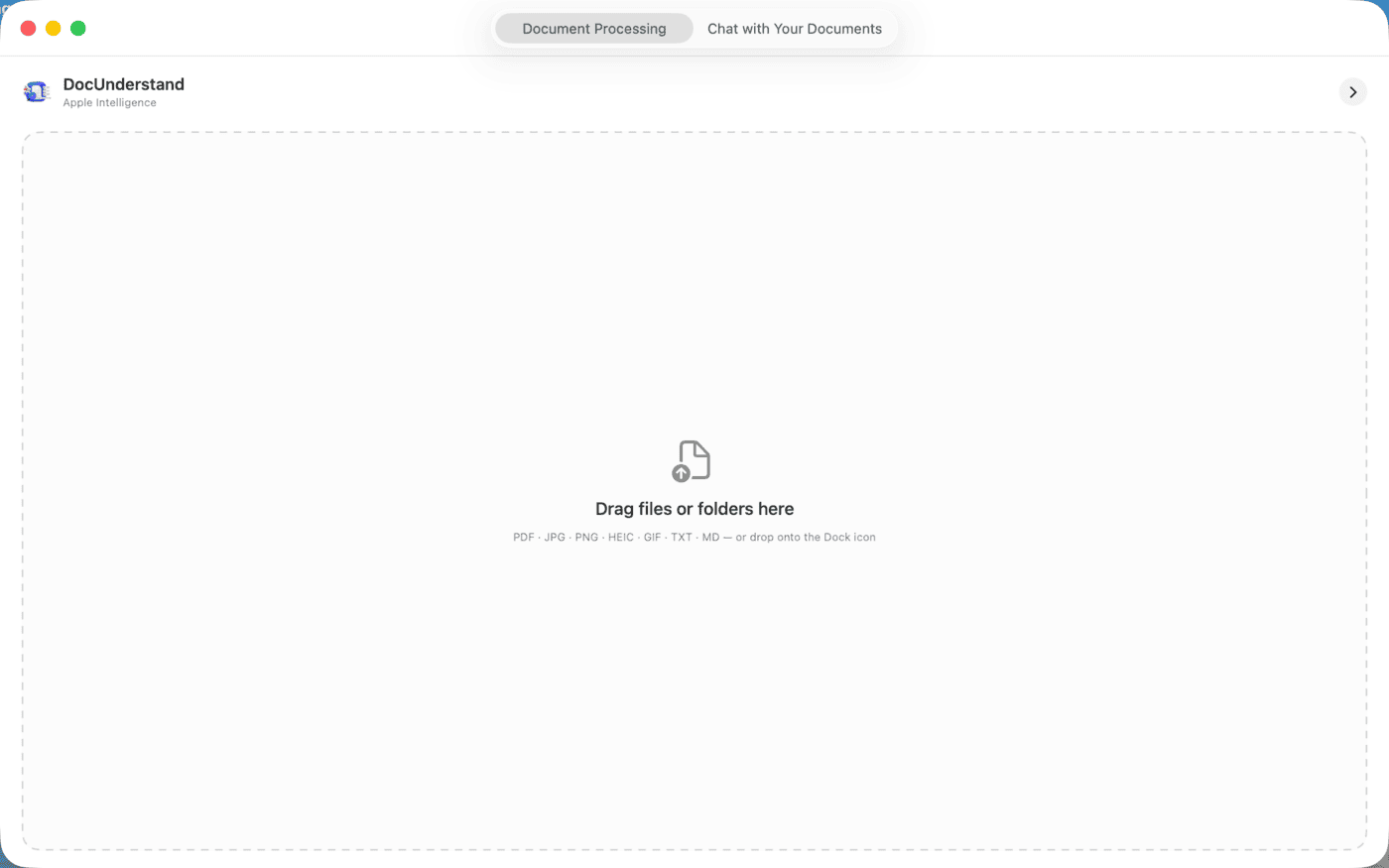
Main window — drop files or folders, the app handles the rest
DocUnderstand processes invoices, contracts, and photos via drag & drop: automatic filenames, Finder tags, data extraction as JSON/CSV. And it does more — build a knowledge base from your documents, ask it questions in chat, and even have it draft support replies via REST API. Built for professional use — for your business and power users alike. 100 % local on your Mac – cloud processing is optional.
Scan_2026-08-15
14.32.11.pdf
2026-08-10 T-Mobile
Mobile Bill 99€.pdf
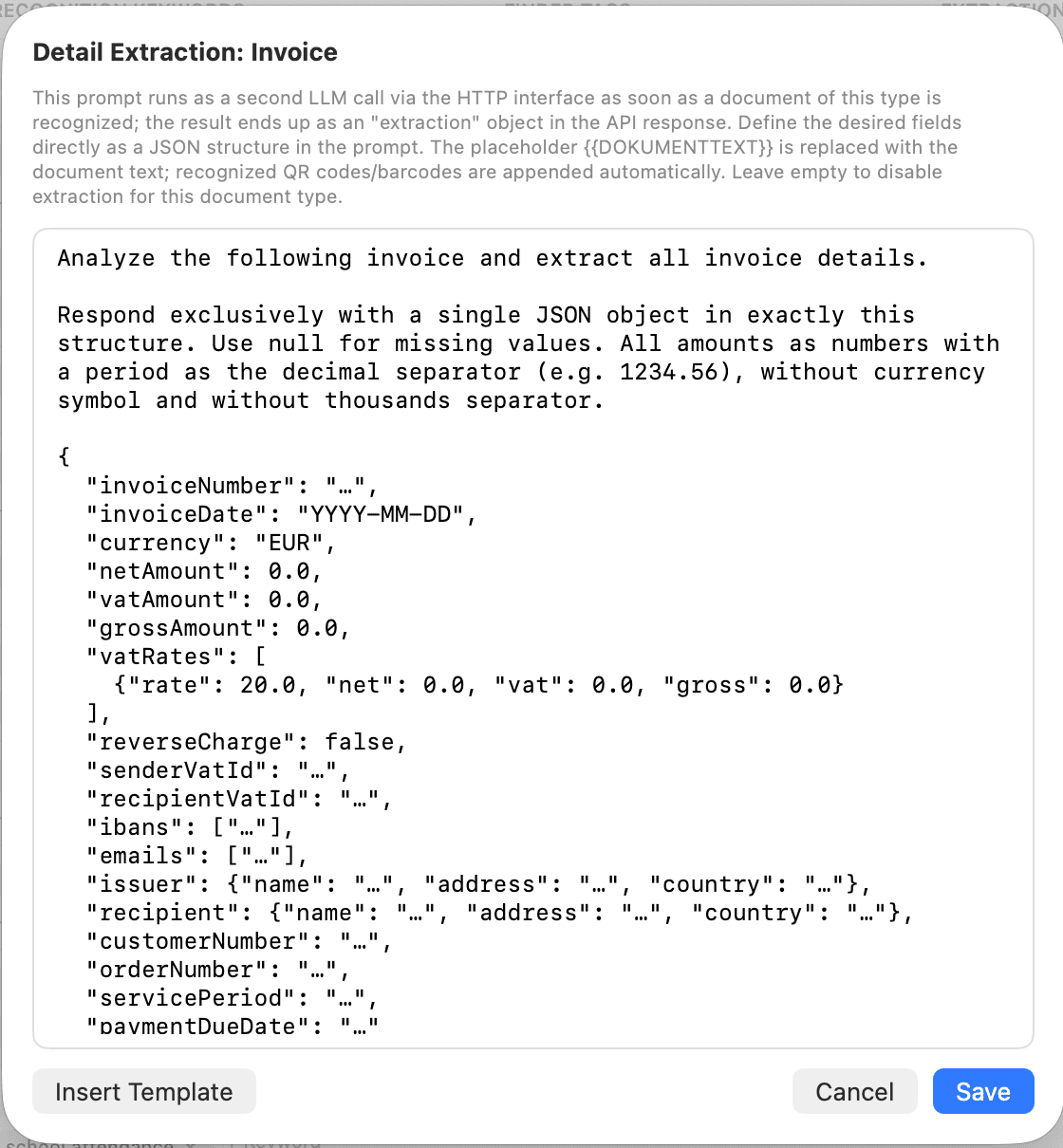
{
  "filename": "2026-08-10 T-Mobile Mobile Bill 99€.pdf",
  "documentType": "Invoice",
  "tags": ["Invoice", "Mobile"],
  "extraction": {
    "invoiceNumber": "RG-2026-081045",
    "invoiceDate": "2026-08-10",
    "currency": "EUR",
    "netAmount": 82.50,
    "vatAmount": 16.50,
    "grossAmount": 99.00,
    "senderVatId": "ATU12345678",
    "issuer": { "name": "T-Mobile Austria GmbH", "country": "AT" },
    "customerNumber": "70123456",
    "servicePeriod": "01.–31.07.2026"
  }
}
Built for professional use — for your business and for power users alike. Filing, knowledge, and integration are equal pillars, and everything can run entirely on your Mac if you choose.
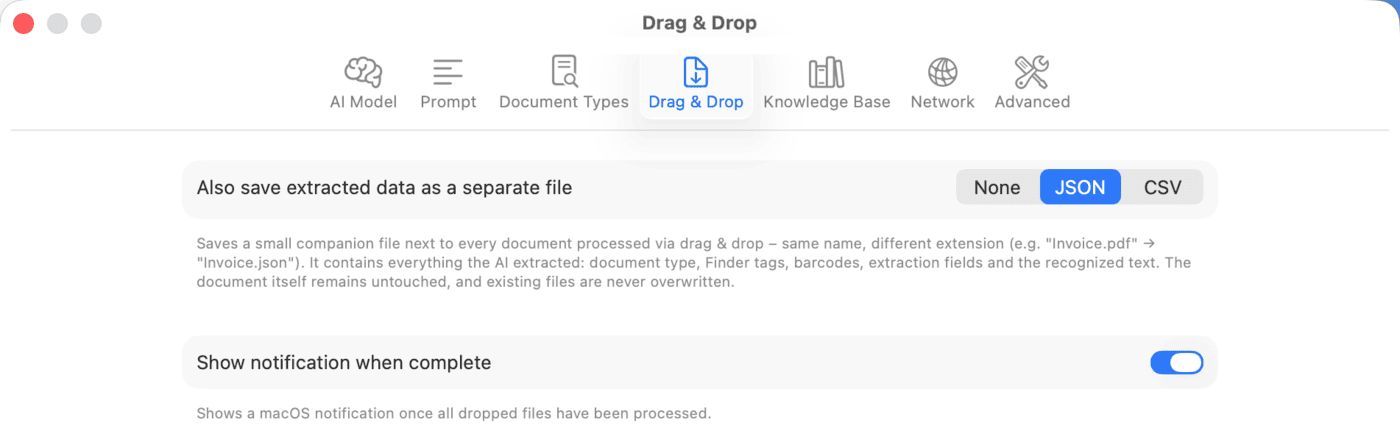
Drag files onto the app — done. Descriptive filenames, automatic Finder tags, and, if you like, a sidecar file (JSON/CSV) with all the extracted data. From photos, the app also reads EXIF, GPS, IPTC, and XMP metadata.
Watch the demo with soundAdd documents to project knowledge bases and ask questions in chat — with clickable citations down to the exact page. Photos can be queried too, and for customer support, DocUnderstand drafts ready-to-send reply suggestions from your own knowledge.
Watch the demo with soundNot an afterthought, but an equal citizen: every feature is also available via REST API — recognize and extract documents, query the knowledge base, draft support replies, manage the knowledge base. With interactive API documentation built into the app, and examples that paste in as ready-to-use FileMaker script steps.
Watch the demo with soundDocUnderstand comes with a local REST API. Any application that can make HTTP requests — e.g. FileMaker, Xojo, scripts, your own tools — can have documents recognized (/process, /extract), query the knowledge base (/ask), draft support replies (/draft-reply), and manage the knowledge base itself.
Drag it onto the app window or the Dock icon — PDF, JPG, PNG, HEIC, GIF, TXT, or Markdown, including entire folders recursively.
Built-in text recognition (OCR) makes even photographed or scanned documents searchable.
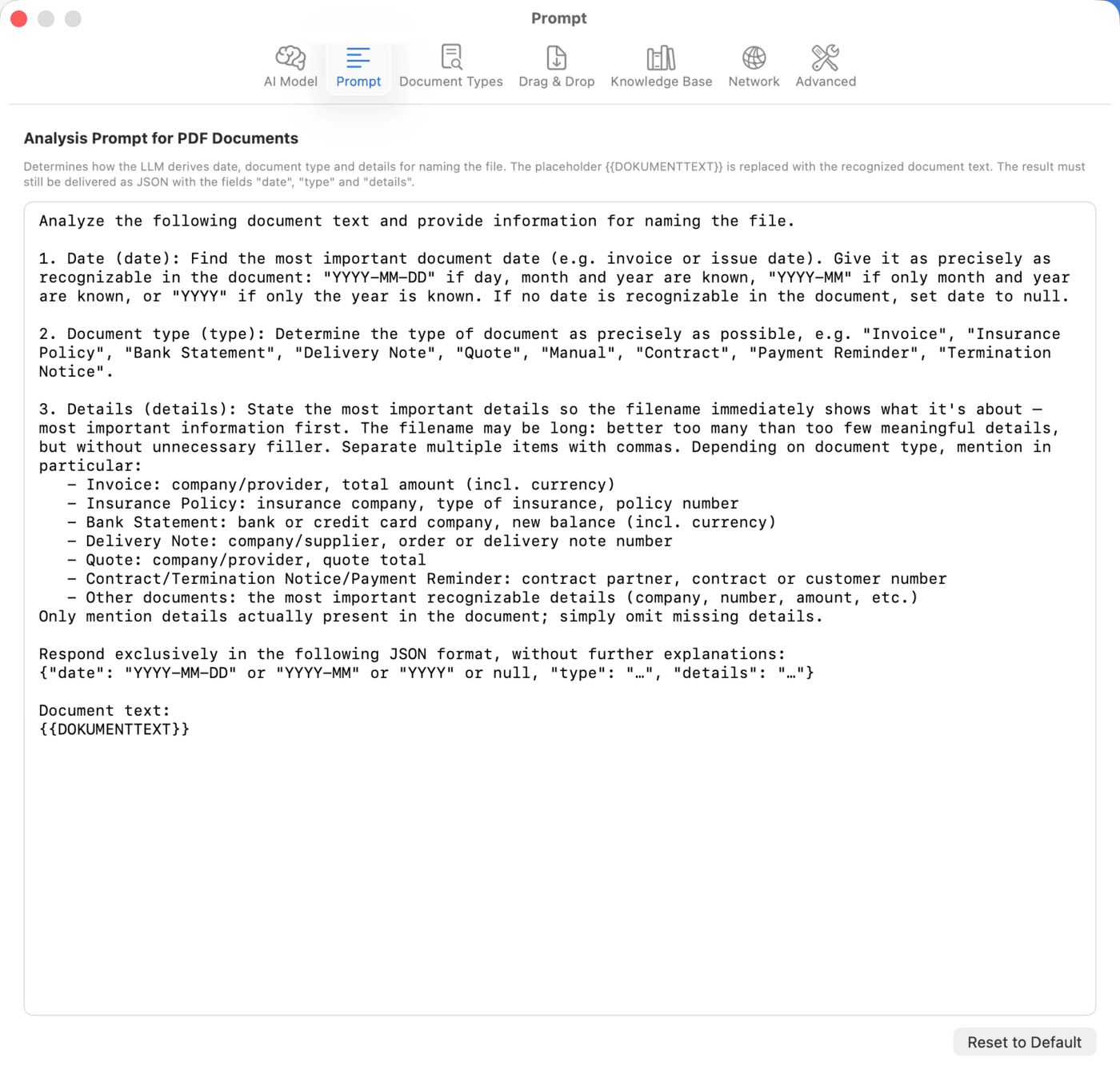
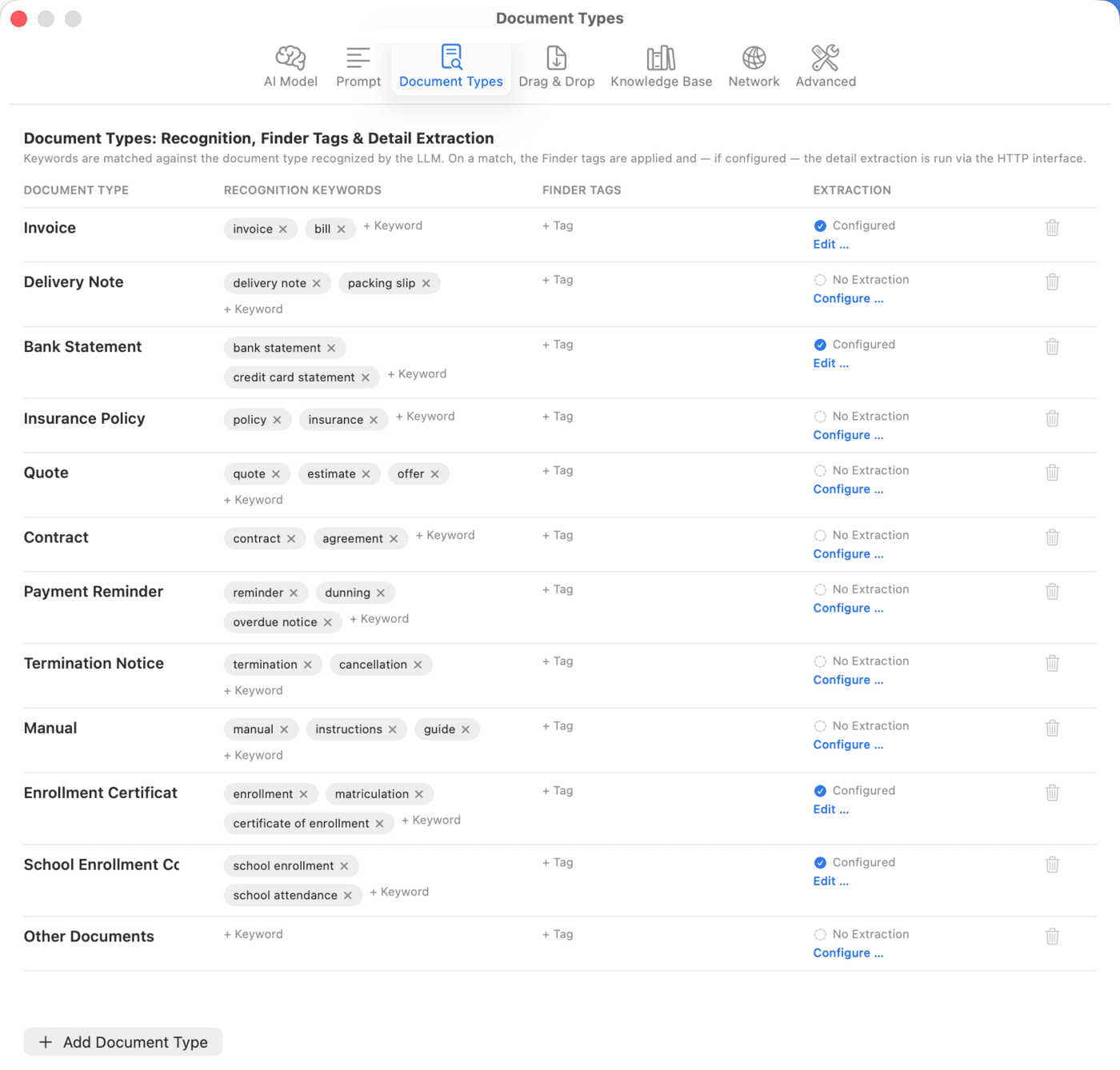
Whether it's an invoice, bank statement, or contract: the AI picks out the key details — optionally right on your Mac.
The file gets a descriptive name and matching Finder tags — instantly findable, with no filing system required.
Drag contracts, invoices, manuals, or meeting notes into a knowledge base — then just ask. Every answer comes with a citation, and indexing runs entirely on your Mac.
Your knowledge base becomes a support assistant: DocUnderstand reads incoming customer inquiries, you enrich them with data from your order system — and get ready-to-send reply suggestions back. All via REST API, all on your Mac.
The incoming email is analyzed: what's it about, which order or customer number is mentioned? You get structured JSON back.
Your system — e.g. FileMaker — uses the extracted number to look up the order: status, tracking, delivery date.
DocUnderstand combines the customer message, order data, and your knowledge base into 1–3 ready-to-send reply suggestions — your team reviews and sends.
curl -X POST http://localhost:8787/draft-reply \
  -H "Authorization: Bearer docunderstand-xxxxxxxx" \
  -H "Content-Type: application/json" \
  -d '{
    "message": "Where's my order 4711?",
    "context": { "order": { "nr": "4711",
      "status": "shipped", "tracking": "DHL 00340434…" } },
    "suggestions": 2
}'{
"suggestions": [
"Hello! Your order 4711 has already shipped. You can track the shipment with DHL 00340434… …",
"Thank you for your message! …"
]
}Every endpoint comes with a description and a ready-made example call using your real port and key — try it right in the app, including a step-by-step guide for the support workflow.
One click copies the examples as real FileMaker script steps to your clipboard — paste with ⌘V in the script workspace, done.
No session handling, no cloud requirement: every request stands on its own, with conversation history simply sent along. Runs only on this Mac by default.
Invoices and bank statements are sensitive. That's why analysis runs directly on your Mac by default – the cloud is never required.
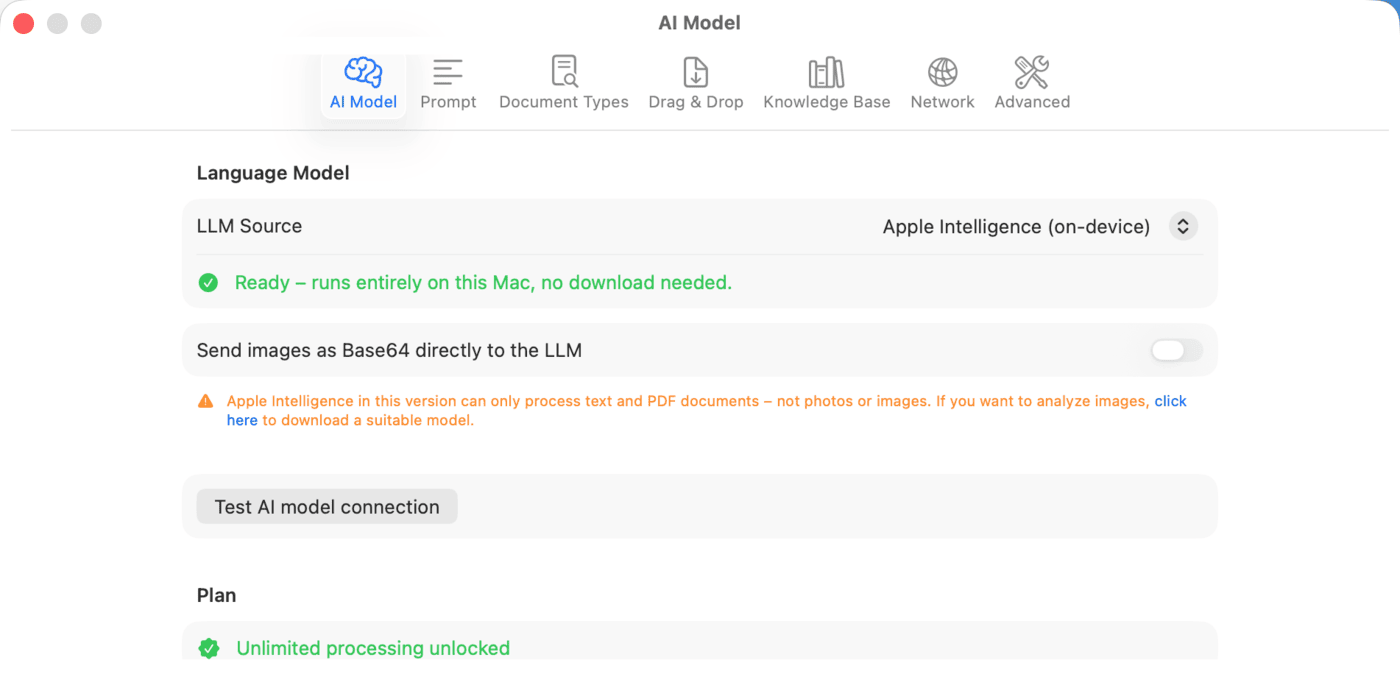
Uses the AI model built into macOS — works instantly, entirely on-device, with no data ever leaving your Mac.
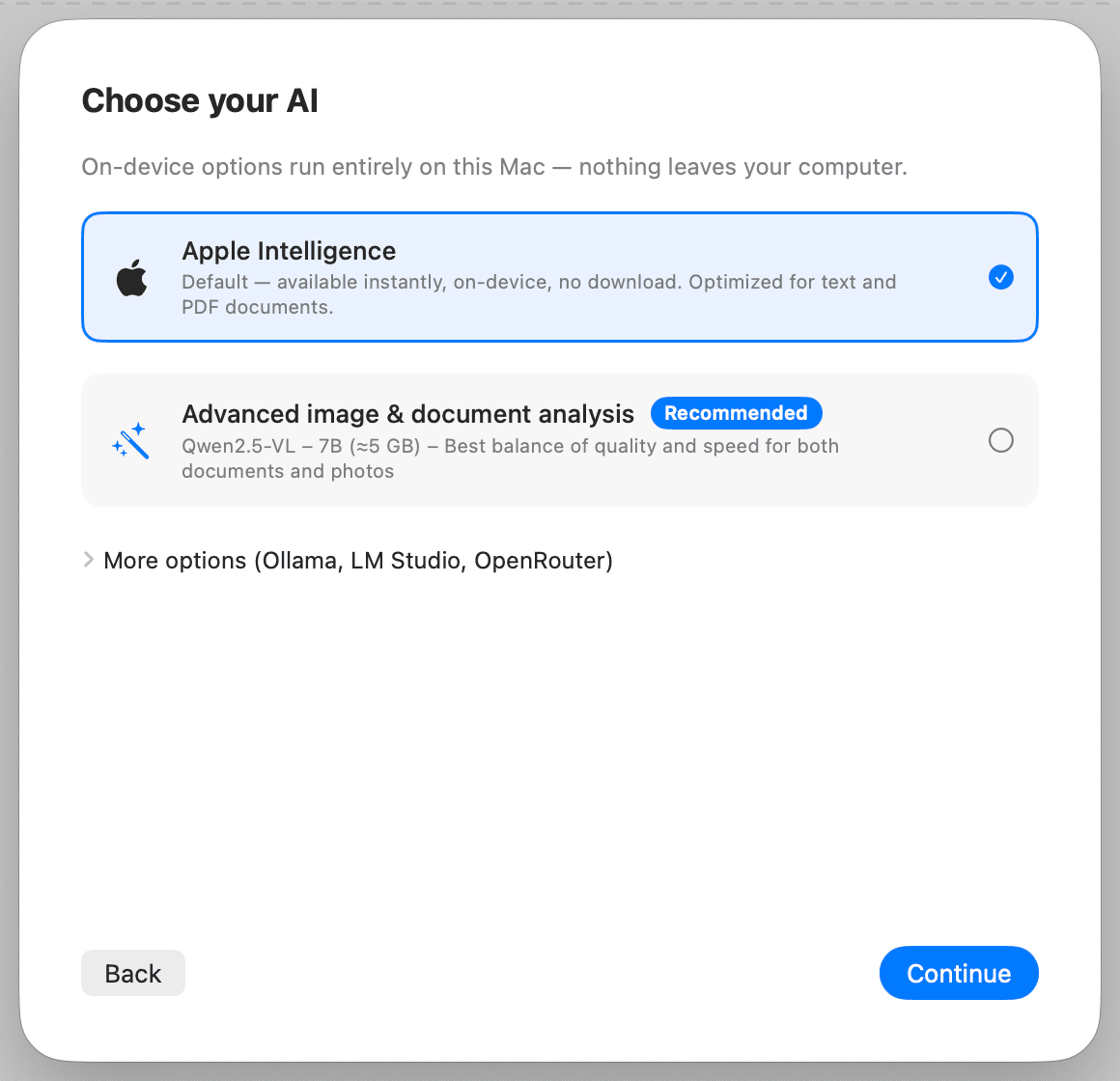
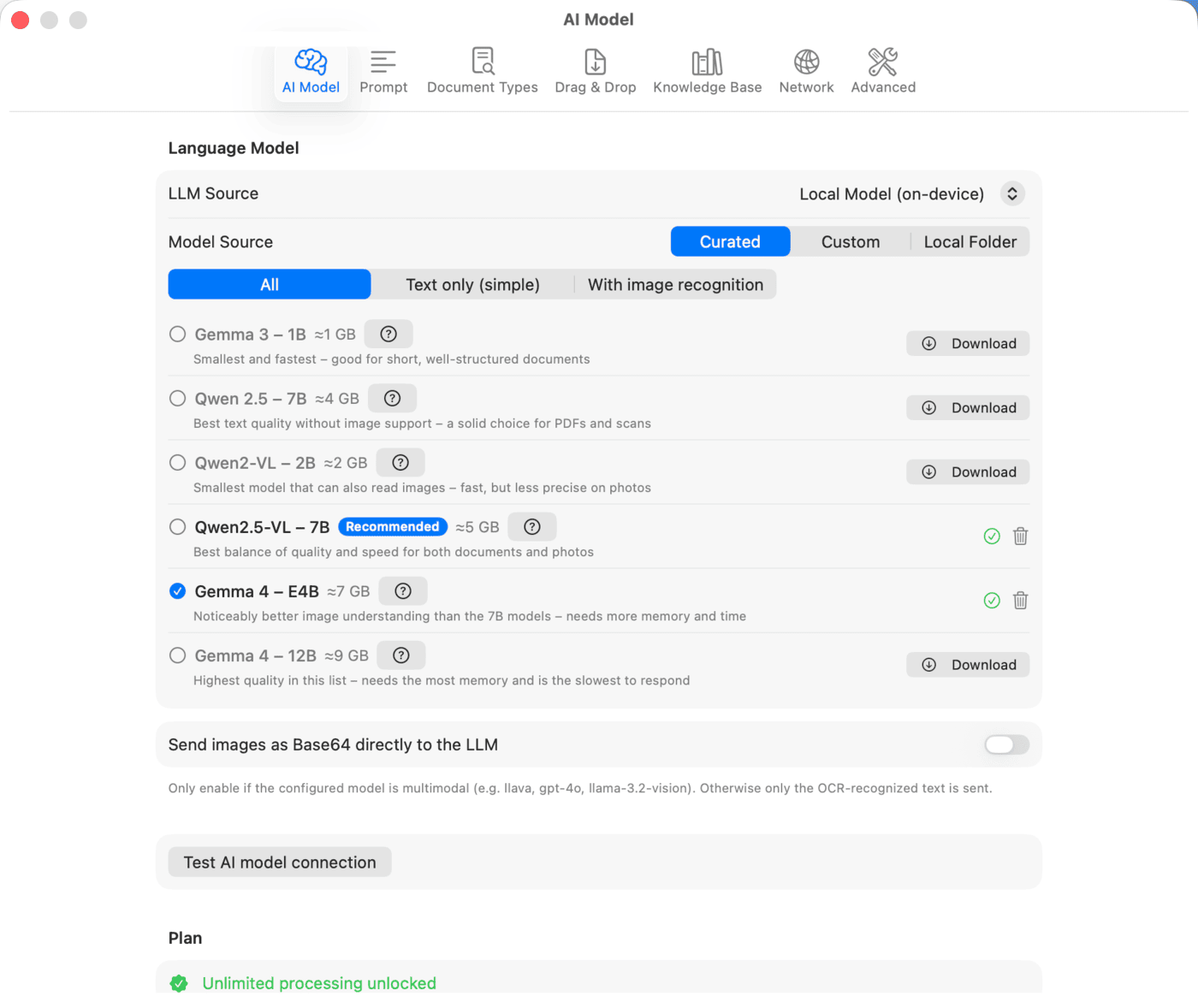
Eight curated models are available right inside the app — download and select with a click, no command line required. Fully usable offline, including image recognition.
Already running your own server? DocUnderstand talks to Ollama, LM Studio, or — if you prefer — OpenRouter in the cloud.
No filing system to learn, no menus to get lost in — just a place to drop your files.
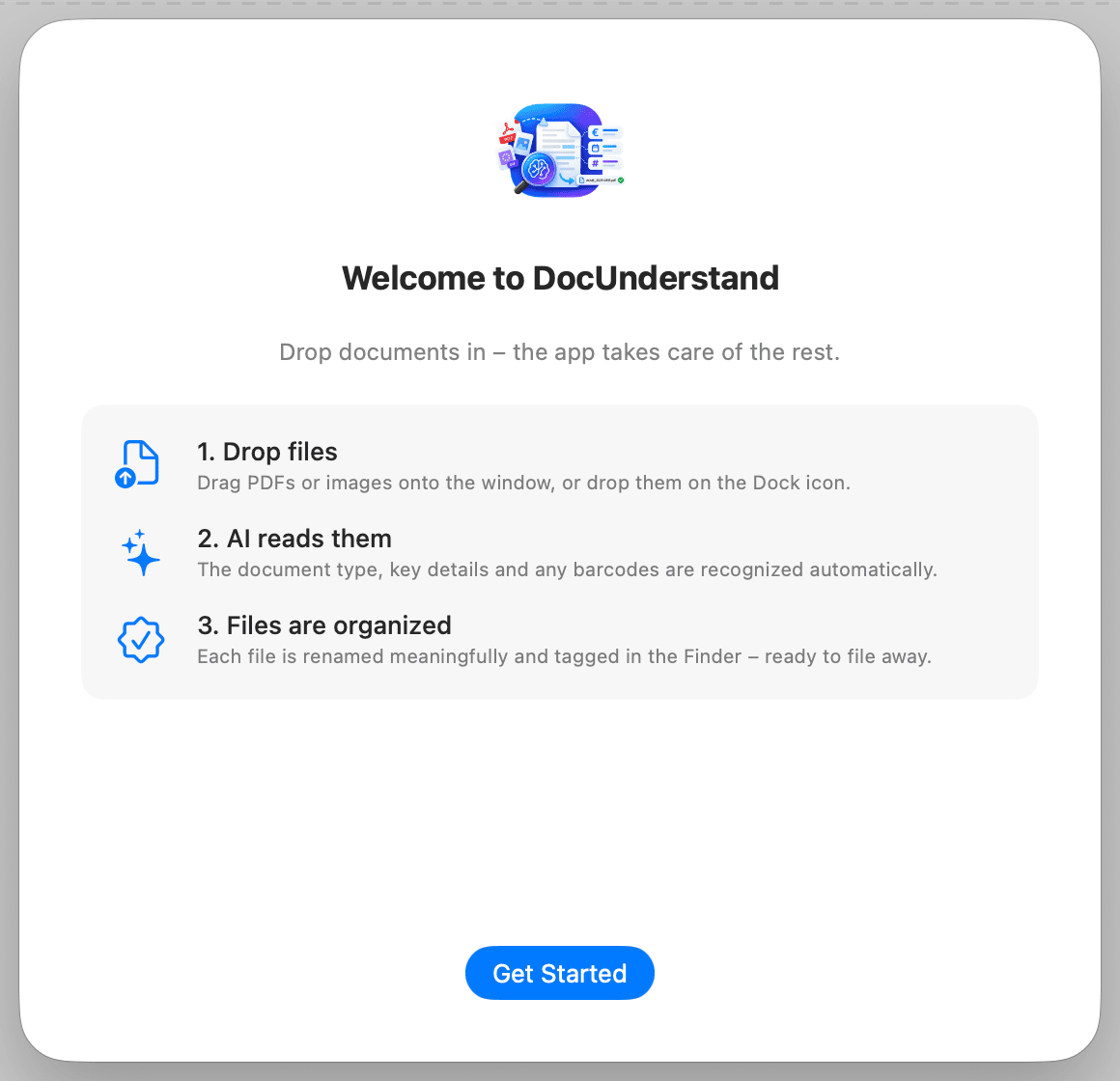
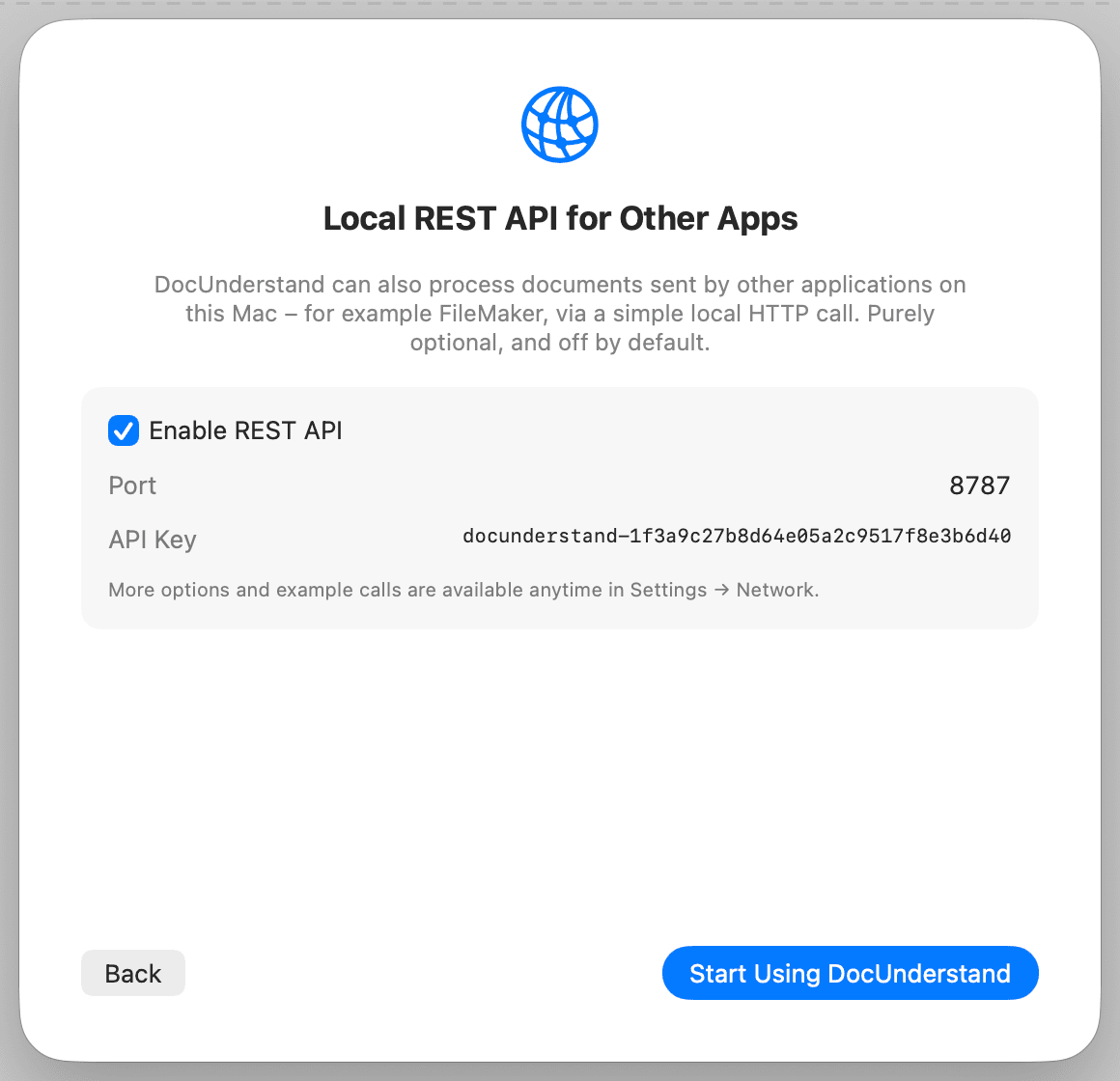
DocUnderstand ships with a local REST API. Any application that can make HTTP requests — e.g. FileMaker, Xojo, scripts, your own tools — can send documents for recognition and get back named files, Finder tags, and structured data.
curl -X POST http://localhost:8787/process \
  -H "Authorization: Bearer docunderstand-xxxxxxxx" \
  -H "Content-Type: application/json" \
-d '{"filename":"Invoice.pdf","mimeType":"application/pdf","data":"<Base64>"}'// Encode PDF container as Base64
Set Variable [ $data ; Base64EncodeRFC ( "base64" ; Document::PDF ) ]
Set Variable [ $body ; JSONSetElement ( "{}" ;
[ "filename" ; Document::Filename ; JSONString ] ;
[ "mimeType" ; "application/pdf" ; JSONString ] ;
[ "data" ; $data ; JSONString ] ) ]
Insert from URL [ Target: $response ; "http://localhost:8787/process" ;
cURL options: "-X POST -H \"Authorization: Bearer " & $$APIKey &
"\" -H \"Content-Type: application/json\" --data @$body" ]
Set Field [ Document::Filename_new ; JSONGetElement ( $response ; "filename" ) ]
Set Field [ Document::Tags ; JSONListValues ( $response ; "tags" ) ]Filename, document type, Finder tags, recognized text, and for known document types, structured fields like invoice number or amount — ready to use right away. For images, also EXIF, GPS, IPTC, and XMP metadata (camera, location, copyright, and more).
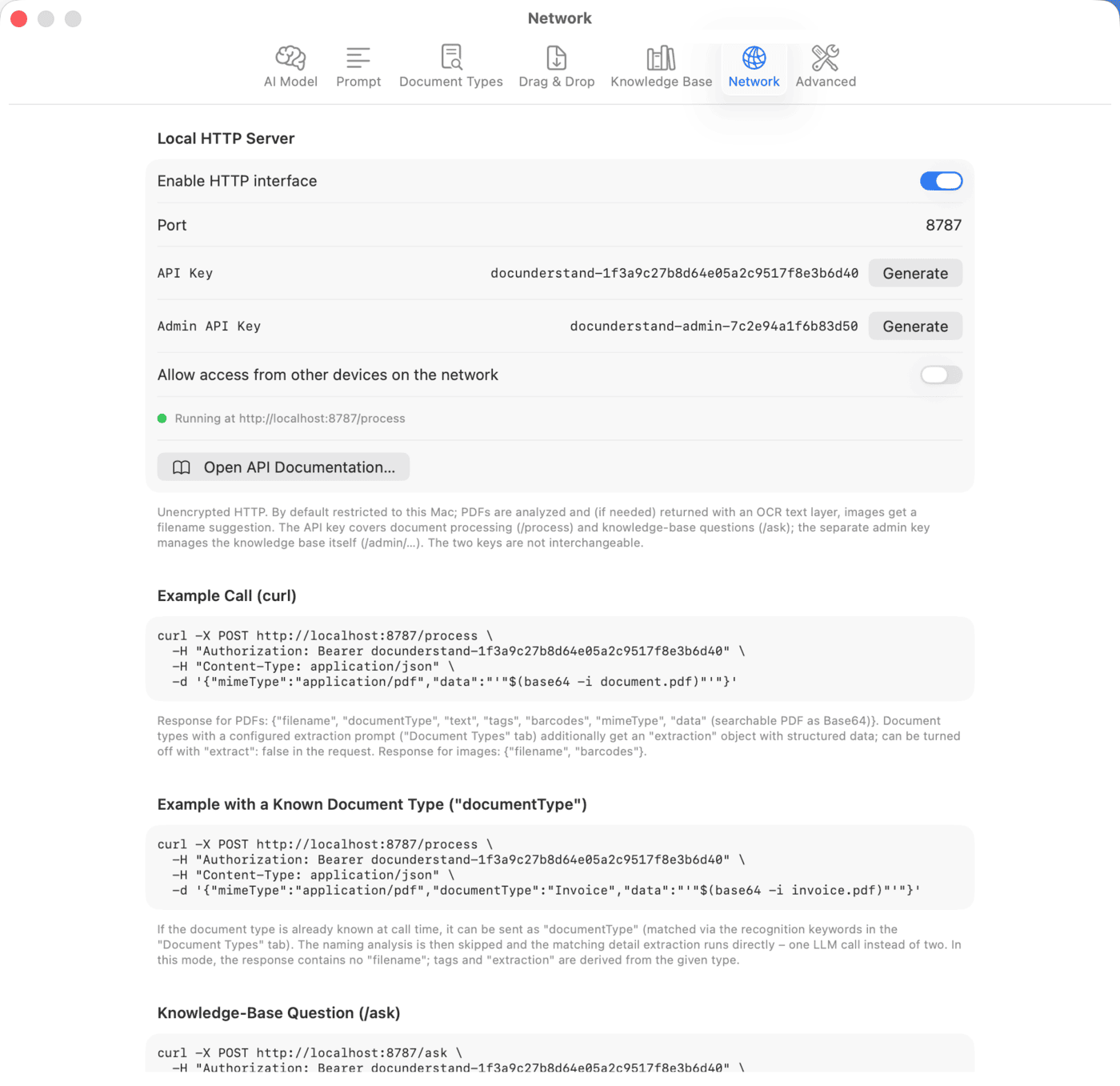
Bound to 127.0.0.1 by default and protected by API keys — one key for requests, a separate admin key for managing the knowledge base. Access from your local network is a deliberate, one-off choice.
Set the port and API keys in the Network settings — or turn it off entirely if you don't need it. The interactive API documentation in the app shows every endpoint, ready to try.
500 requests free — documents and chat questions combined, with no time limit. After that, choose the plan that fits how you work.
500 requests included — processed documents and chat questions combined. A counter always shows where you stand.
Unlimited document processing — naming, tagging, extracting, also via REST API.
Everything in the subscription plan plus the full knowledge base — cancel monthly.
The full Pro plan billed yearly — about two months free compared to paying monthly.
Prices as listed on the App Store; they may vary slightly by country. Subscriptions can be canceled anytime, directly in the App Store.
/process), extract specific data (/extract), query the knowledge base (/ask), draft support replies (/draft-reply), plus management endpoints for projects, documents, and question-answer pairs, secured with a separate admin key. The interactive API documentation in the app shows ready-made examples for every endpoint — for FileMaker, even as pasteable script steps.Start for free, 500 requests included.